
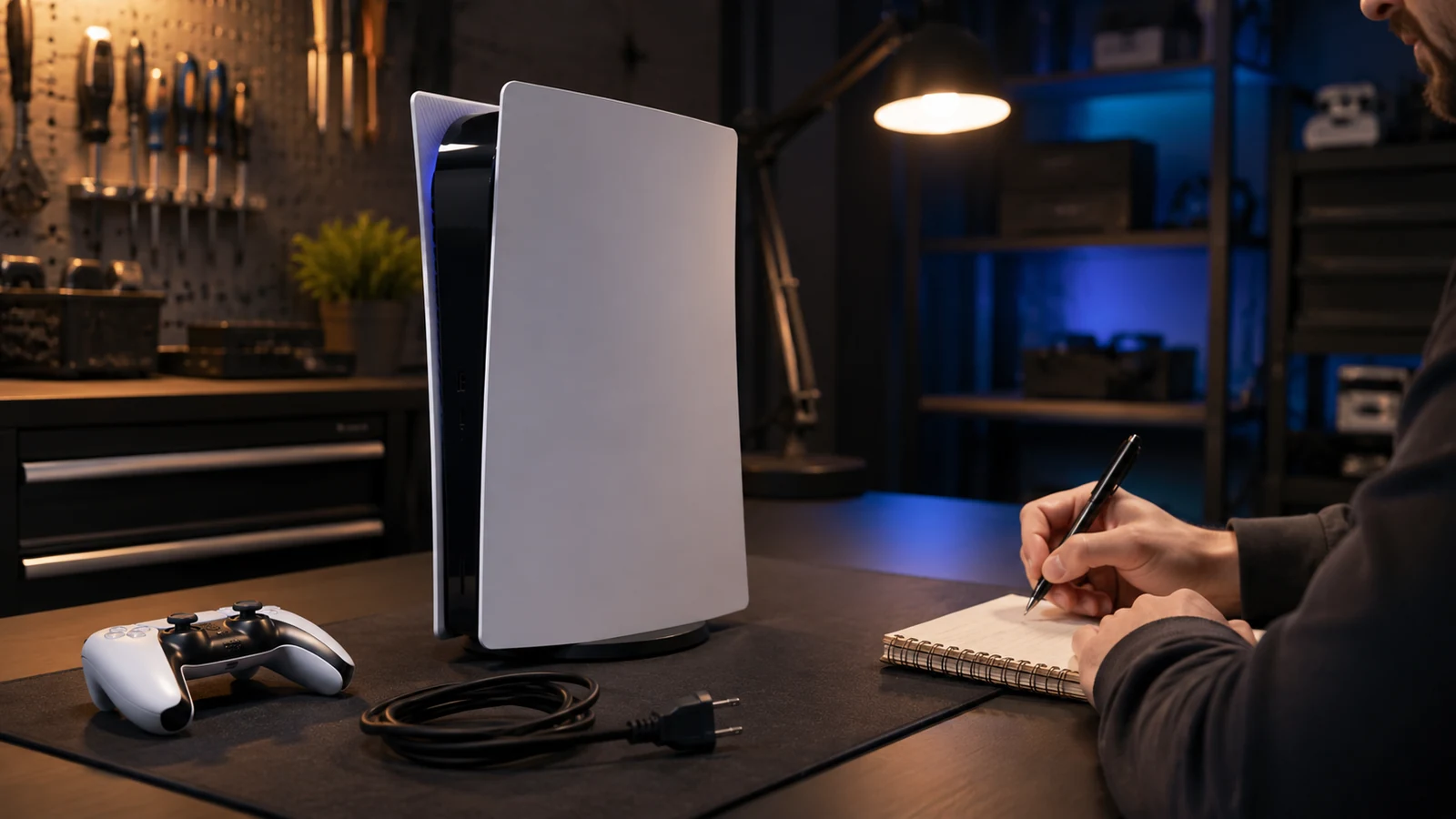
Write down the exact power state
Press the console's power button once and watch and listen. Do not keep pressing it in the hope that the result will change. Write down what happens instead of guessing that the power supply or main board failed.
- No beep and no light: the console shows no external response. Check the safe cable and outlet branch below.
- One beep but no light: the button registered, but the console did not reach a visible startup state. Record whether a disc or controller command produces the same result.
- A blue or white light appears, then the console turns off: stop repeated starts. PlayStation treats immediate power loss as its own repair path.
- The light stays solid white: PlayStation says the console is powered on. If the screen is blank, use the PS5 HDMI and no-picture guide instead of calling this no power.
- The light remains blue or blinks white: PlayStation classifies that as an error state. One unplugged wait may be appropriate if the console is otherwise safe.
Check the outlet and cable once
Turn the console off and disconnect power. Look at the cable without bending or opening it. Do not reuse a cable with a cut jacket, bent contact, scorch mark, melted area, or loose fit. If everything is dry, cool, and intact, connect the PS5 directly to a known-working wall outlet. Bypass a questionable strip, extension lead, travel adapter, or battery backup for this test.
Compare the normal power cable with one known-good, compatible cable only if its connector and rating match the console. Push it in normally without forcing it. Change one thing at a time and record the result. A cable comparison can narrow the external path, but it cannot prove which internal part is healthy or failed.
If the console was connected during a surge, power outage, liquid event, or burning smell, skip this test. Reapplying power can turn an uncertain fault into a safety problem.
Use one controlled power cycle
If the indicator stays blue or blinks white, PlayStation's current guidance says to unplug the console, wait three minutes, reconnect it, and turn it on. Use that sequence once. Keep the PS5 on a firm surface with clear vents and enough space around it.
If the console turns on and then fails after warming up or during a game, use the game-console overheating guide. Do not keep running a heat-sensitive console to reproduce the shutdown. Dust, airflow, power delivery, and internal faults can produce overlapping symptoms, and the outside behavior alone does not settle the cause.
Try Safe Mode only if the console reaches the second beep
Safe Mode is useful only when the PS5 can enter it. PlayStation says to turn the console off, then press and hold the power button. Release after the second beep, which sounds about seven seconds after the first. Connect the controller with a USB cable and press its PS button.
If there is no second beep, stop repeating the hold. Recheck the safe outlet and cable conditions once, then use PlayStation Repairs or a qualified inspection. A one-beep console that never reaches Safe Mode has not proved an internal cause.
If Safe Mode opens, start with the least disruptive option that matches the symptom. Restart PS5 ends Safe Mode normally. Change Video Output is for a blank screen. PlayStation says Repair Console Storage does not erase data. By contrast, Reset PS5 deletes user data, and Reset PS5 (Reinstall System Software) deletes user data and removes the system software. Do not choose either reset as a casual power test.
Protect saves and account access
If the console reaches the home screen, use the brief working window to confirm that important saves are synced or backed up through a supported PlayStation path. Do not postpone that step to run a long stress test. Storage repair and reset options do not carry the same data risk.
Keep the account password, two-step codes, recovery codes, and payment details private. A technician can inspect a power fault without asking you to post those details. If account access is also broken, use PlayStation's official recovery path separately from the hardware diagnosis.
Bring useful evidence to an inspection
Record the PS5 model, whether it was in rest mode or fully off, the exact beep and light sequence, how long it stays on, whether the screen ever shows a picture, and what changed before the first failure. Include the result from the direct outlet, known-good cable, three-minute unplugged wait, and Safe Mode attempt. Bring the normal power cable and any adapter or strip that was in use.
Budget Repair can inspect a PS5 in Lawrence and explain what the evidence supports before repair begins. The part, price, data risk, and result depend on the console and test findings. See the broader game console repair service or request a PS5 inspection with the exact state you recorded.
Editorial sources
Checked September 6, 2026 against PlayStation's PS5 power-issue guidance, power-indicator reference, and Safe Mode instructions. PlayStation supplies the official power-state, three-minute unplugged wait, second-beep, storage-repair, reset, and repair boundaries. Budget Repair added the state checklist, safety limits, local handoff, and related repair links. The article does not identify an internal part or promise a repair result.