
Record the message, model, and port
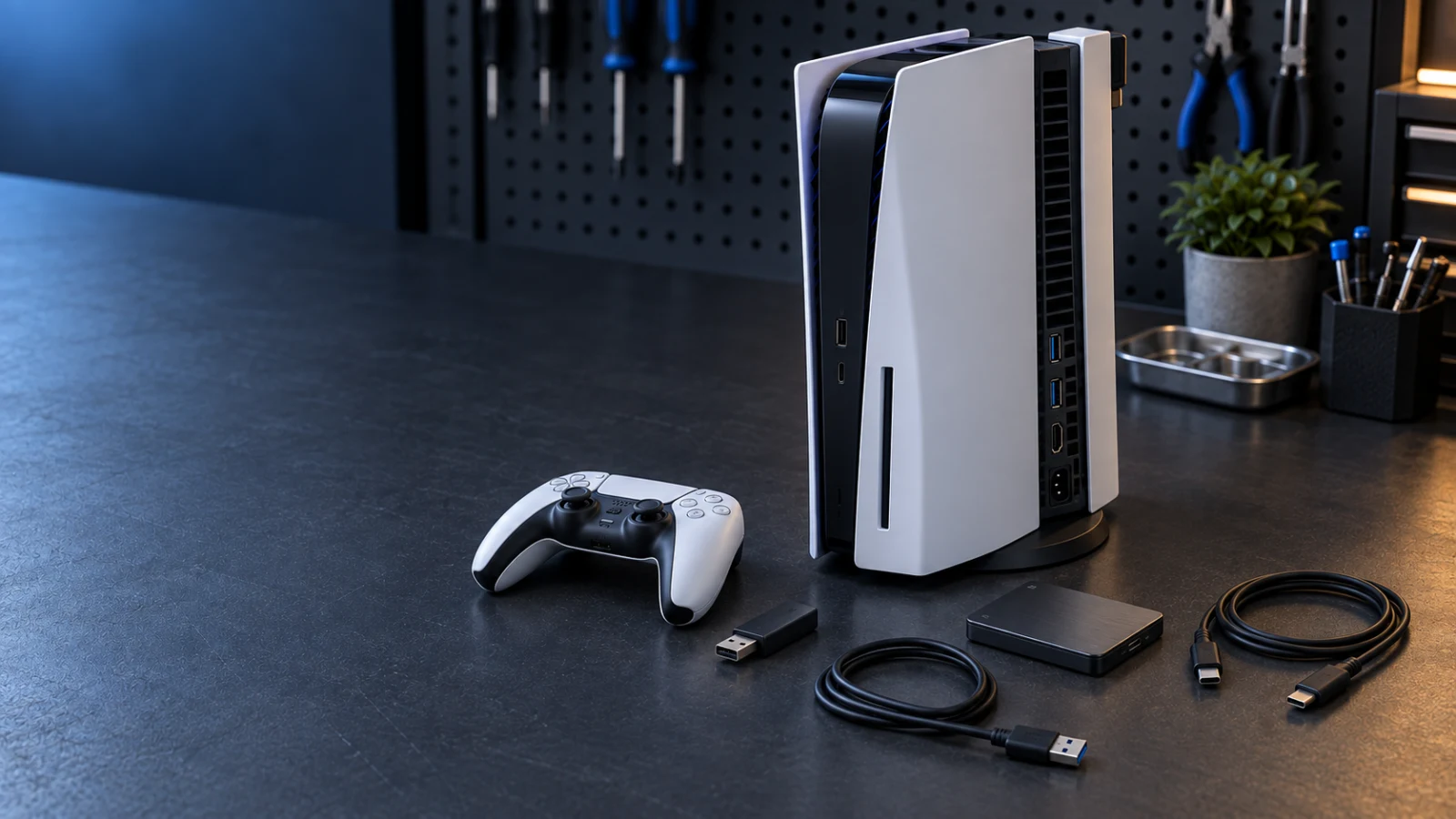
Start with the exact words on screen and the moment they appear. Note whether the PS5 is starting, already at the home screen, entering Rest Mode, waking, or launching a game. List every connected USB device, including storage, controllers, headsets, cameras, hubs, charging docks, adapters, and cables.
Find the console model number before treating every port as interchangeable. Sony documents different front layouts for the original CFI-1000 model group and the later CFI-2000 and CFI-7000 groups. All have four USB ports, but their connector types and supported uses differ. Match the accessory to Sony's port guide before comparing results.
- One device triggers the message. Keep that accessory and its cable in scope.
- One physical port triggers it. Keep the port and connector condition in scope.
- Both front or both rear ports fail. Record the port group instead of calling the whole console bad.
- Every suitable port fails. Test only with known-compatible items before moving to software and service checks.
A controller that merely will not charge is a narrower problem. If other USB devices work normally, use the PS5 controller charging guide instead.
Protect USB extended storage first
A quick unplug is not safe when the console is reading from or writing to USB extended storage. Close games and apps that use the drive. Follow Sony's safe-removal flow, wait for the console to say the drive can be disconnected, and then remove it before the one-device test.
Do not use the error message as a reason to format, repair, rebuild, or erase a drive. Do not pull a drive during startup, transfer, installation, or game activity. If the drive disconnects on its own, clicks, becomes hot, or contains the only copy of important data, stop ordinary testing and plan for storage-specific help.
Once the drive is safely out, leave it out of the first comparison. This avoids mixing a storage problem with a controller, headset, adapter, or port test.
Reduce the test to one accessory
Shut the PS5 down fully. Remove every nonessential USB device. Inspect the unplugged cable ends and ports under good light without inserting a tool. Look for a bent shell, damaged tongue, packed debris, discoloration, looseness, or a plug that no longer sits squarely.
Choose one simple accessory that is known to work and is supported in the selected port. Use its known-good cable when a separate cable is required. Start the console with only that item connected and record whether the message appears, whether the device receives power, and whether the PS5 recognizes it.
| Result | What to keep in scope | Next safe check |
|---|---|---|
| One accessory fails everywhere | The accessory and its cable | Try another compatible accessory and cable once. |
| Several accessories fail in one port | That port and its connector condition | Compare one documented compatible port. |
| Rear ports fail but a suitable front port works | The rear port group and recent damage or repair history | Stop adding devices and preserve the pattern for service. |
| Every suitable port fails | Console-wide USB behavior, software state, and hardware | Complete one normal update check, then arrange diagnosis. |
Do not use a cheap hub to make the comparison easier. A hub adds its own power, cable, and compatibility variables. Do not buy a replacement port or board part from this table. The test shows where the symptom repeats. It does not see the circuit.
Compare the cable and a documented port
If the accessory uses a removable cable, keep the accessory and port unchanged while you swap only the cable. Use a cable that supports the accessory's required power and data function. A charge-only cable may power a device without carrying the data it needs.
Next, keep the known-good accessory and cable together and move them to one other port that Sony lists for that use. Do not assume that a matching connector means every function is supported. PS VR2, USB extended storage, and other high-speed devices have specific port requirements.
Record power and data separately. A device may light up but not connect, connect and then drop, or trigger the message only after it begins working. Those are different observations. If touching or moving the plug changes the result, stop using that port rather than holding the cable at an angle.
Separate active errors from Rest Mode charging
If the PS5 and accessory work while the console is on but charging stops in Rest Mode, the exact Too many USB devices connected guide is no longer the best match. Sony provides separate USB power settings for Rest Mode, including Always, 3 Hours, and an Adaptive option on supported CFI-2000 model-group consoles.
Check Settings > System > Power Saving > Features Available in Rest Mode > Supply Power to USB Ports. Change only that setting when the symptom is limited to Rest Mode charging, then test once. A Rest Mode power setting does not explain a port that is loose, hot, damaged, or failing while the console is active.
Check for a normal system update once
After the stripped-down hardware comparison, check the installed PS5 system software and use Sony's normal update path. Keep the console on reliable power and do not interrupt the update.
Do not reinstall system software for this message. Sony warns that reinstalling deletes all console data. A factory reset, database rebuild, or system-software reinstall is not justified when the test has not separated the accessory, cable, port, and port group.
Repeat the same one-accessory test after a successful normal update. If the result is unchanged, do not loop through updates or resets. Keep the before-and-after evidence.
Read the pattern before arranging repair
The most useful service note is specific. Include the PS5 model, system version, exact message, port location, accessory, cable, whether storage was attached, and whether the connection provided power, data, both, or neither. Add recent impact, liquid, overheating, prior repair, or cable strain.
A repeatable one-port or one-port-group result supports a physical inspection. Failure across every suitable port with more than one known-good accessory also supports service, but it still does not identify the failed part. Get help sooner for visible connector damage, looseness, heat, odor, sparking, or power that cuts in and out.
For another PS5 connector problem, read the PS5 HDMI port guide. Budget Repair's game console repair page explains local service in Lawrence. To request an inspection, send the model, port, accessory, cable, and one-versus-all-port result through the instant quote form. Inspection comes before any confirmed cause, part, price, turnaround time, or repair result.
Editorial sources
Checked September 14, 2026 against PlayStation Support's PS5 USB ports guide, accessories support, system-software instructions, and hardware and repair route. Sony supplies the model, port, accessory, storage, update, and repair boundaries. A recent rear-port report using the exact message supplies symptom language only. It does not establish a cause or repair. Budget Repair added the one-variable test order, safety limits, evidence record, and local service links. Budget Repair is not affiliated with Sony or PlayStation.