
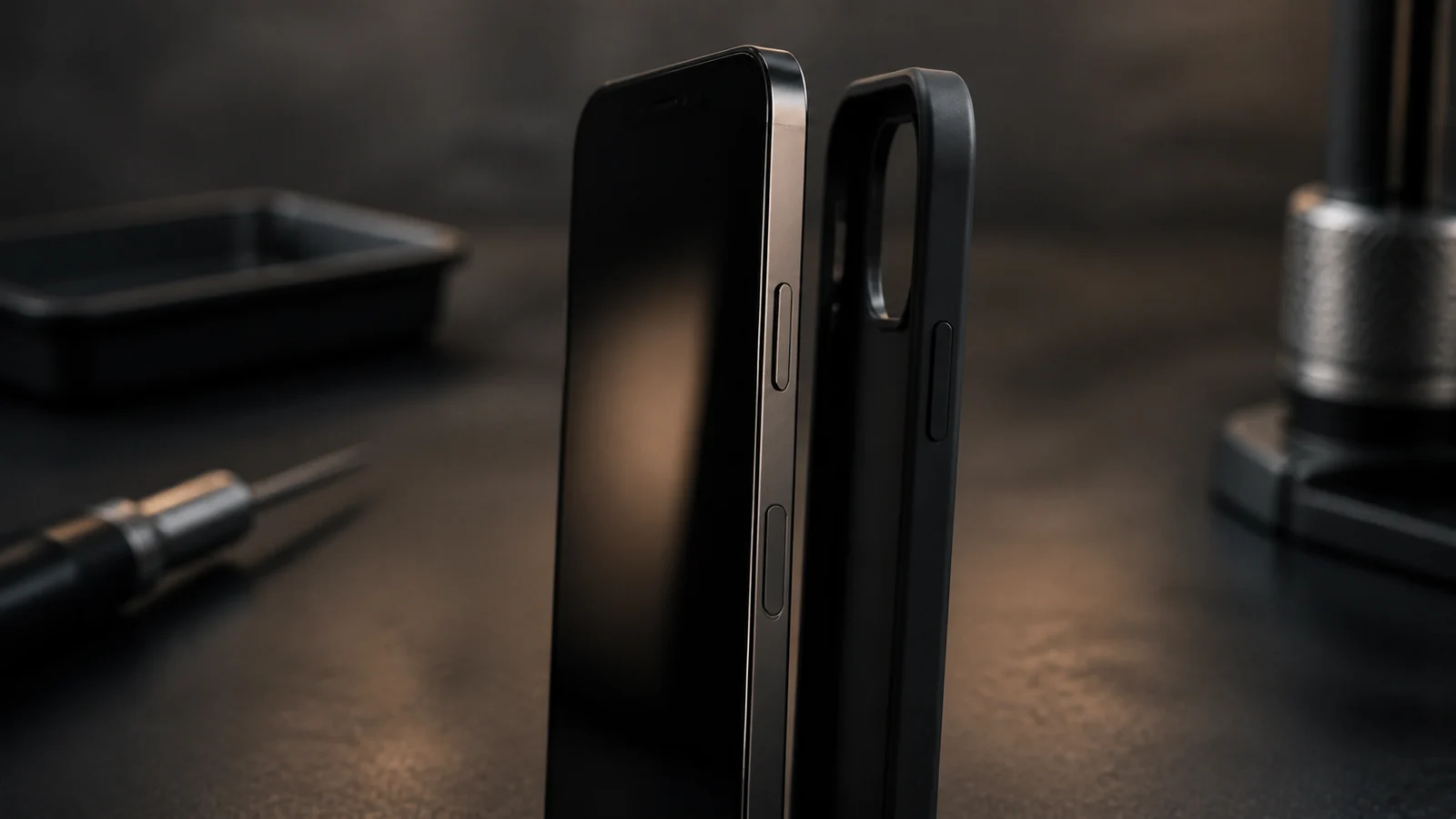
Start with the case and the button opening
Take off the protective case or film. A tight or shifted case can hold the side button down, miss the control, or make a normal click feel weak. Test the uncovered button once with the phone resting on a stable surface.
Apple's current guidance allows a visual debris check and a soft, lint-free cloth around the button. Keep the same boundary on other phones: wipe the outside only. Do not push a pin, blade, pick, cotton swab, oil, alcohol, contact cleaner, or compressed gas into the gap.
- Works normally without the case: the case or its button insert is the likely problem. Replace or reposition the case before considering phone repair.
- Feels firm and clicks but does nothing: check the button's assigned action, the phone's state, and the screen before naming a hardware fault.
- Feels soft, sunken, loose, jammed, or intermittent: stop repeated pressing. Physical inspection is the safer next step.
- Triggers by itself or causes restart loops: power the phone down through on-screen controls if it is safe and back up accessible data before service.
Make sure the button is supposed to do what you expect
On recent Samsung Galaxy phones, the old Power and Bixby controls are combined into a multifunction Side button. A short press, long press, and double press can do different things, and the long press can open an assistant instead of the power menu. Samsung says the options vary by model and software version.
On an iPhone, click speed, press-and-hold behavior, and accessibility settings can also change how the side or Home button responds. These settings do not explain a button that is physically stuck, but they can explain why a firm click launches the wrong action or seems delayed.
Record the exact behavior:
- Does one short press wake or lock the screen?
- Does a long press open an assistant, power menu, or nothing?
- Does a double press work while a single press fails?
- Does the result change after removing the case?
- Did the behavior change after an update, setting change, drop, liquid exposure, or prior repair?
That pattern is more useful than saying the power button is “dead.” It separates control mapping from a physical button that cannot register a consistent press.
If the phone is still on, use temporary on-screen controls
Temporary controls can help you lock, restart, or shut down a phone while you protect data and arrange service. They do not repair the button, and they may not turn on a phone that is fully powered off.
On iPhone
Apple's current iOS 26 guide places AssistiveTouch under Settings > Accessibility > Touch > AssistiveTouch. The on-screen menu can replace common button actions and includes Restart. On supported Face ID models, it can also replace some side-button confirmation steps.
On Samsung Galaxy
Samsung provides a Power icon in Quick settings on current Galaxy phones. Swipe down with two fingers, select the Power icon, and choose Power off or Restart. Samsung's Assistant menu under Accessibility > Interaction and dexterity can also provide common on-screen controls while touch still works.
Menu names can vary by model and software. Use only the control shown on your phone. If the screen or touch is unreliable, do not depend on an on-screen workaround as your only way to power down later.
If the phone looks dead, separate four different problems
A black screen after pressing the button does not prove the button failed. Put the phone in the narrowest group you can support:
- Black display, phone still running: it rings, vibrates, makes sounds, connects to a known computer, or responds through an already paired device. Follow the black-screen guide and protect data.
- Battery or charging problem: there is no response, the phone was already low, or a known-good charger and cable produce no stable charging sign. Keep wired-port problems in the charging-port path.
- Frozen phone: the screen or app stopped before the button appeared to fail. Use the manufacturer's exact restart instructions for that model. Button combinations vary, and they cannot work when the required physical control is truly broken.
- Physical side-button fault: the phone charges or stays on, but the uncovered button remains jammed, loose, intermittent, or unresponsive across the actions it should support.
Use one known-good charger, cable, and outlet when the model supports that charging method. Give a deeply discharged phone time to show a stable sign. Do not cycle through unknown chargers, flex the connector, or keep forcing the button while charging.
Check for damage before you keep testing
A recent drop can deform the frame or move the button even when the glass looks intact. Liquid can reach the switch or flex cable before corrosion becomes visible. A prior screen, frame, battery, or back-cover repair can also change the button's alignment.
Stop normal use and charging for swelling, heat, odor, hissing, smoke, liquid inside the device, a lifting screen or back, or exposed parts. If water or another liquid may be involved, use the phone water-damage guide. Do not bury the phone in rice, heat it, or keep pressing the button to “work the moisture out.”
Back up what you can before the phone powers off
If the phone is still unlocked and usable, connect it to power safely and make a current backup through the manufacturer's supported path. Confirm the backup date and the content you need. A cloud sync icon or an old backup is not proof that today's photos, messages, app data, and authentication details are recoverable.
Also save:
- phone model, storage size, and serial or IMEI when available
- a short video showing the uncovered button and the phone's response
- whether short, long, and double presses behave differently
- charging, sound, vibration, call, screen, and touch results
- drop, liquid, heat, swelling, or prior-repair history
- purchase record and current warranty or service status
Do not factory-reset the phone to test a physical button. A reset can erase the evidence and your data without changing a damaged control.
What a repair inspection should answer
A remote test cannot tell whether the failed part is the external button, an internal switch, a flex cable, frame alignment, board connection, battery state, display, or another power component. A useful inspection should tie the diagnosis to the exact model and physical condition.
Ask whether the quote covers the control alone or a wider power and display diagnosis. Also ask what data handling, parts, warranty, turnaround, and post-repair tests are included. Those details vary by model and condition, so a responsible shop should confirm them after inspection rather than promise them from one symptom.
Where Budget Repair fits
Budget Repair can review the button feel, case fit, charging and display clues, damage history, model, and service options before recommending a repair path. For an iPhone, start with iPhone repair. For a Galaxy phone, use Samsung repair.
When you are ready, request an initial phone assessment and include the evidence above. Inspection comes before a confirmed part, final price, turnaround, or promise that the phone can be powered on without data risk.
Editorial sources
Checked August 22, 2026 against Apple's current button inspection and repair guidance, iOS 26 AssistiveTouch controls, and side and Home button settings, plus Samsung's current Galaxy Side button guidance and Assistant menu controls. Budget Repair added the case-versus-control, battery, display, freeze, damage, backup, evidence, and service classifier. Current owner reports were used only to confirm the search language and no-boot ambiguity, not as repair authority, a universal boot method, or an incidence estimate.