
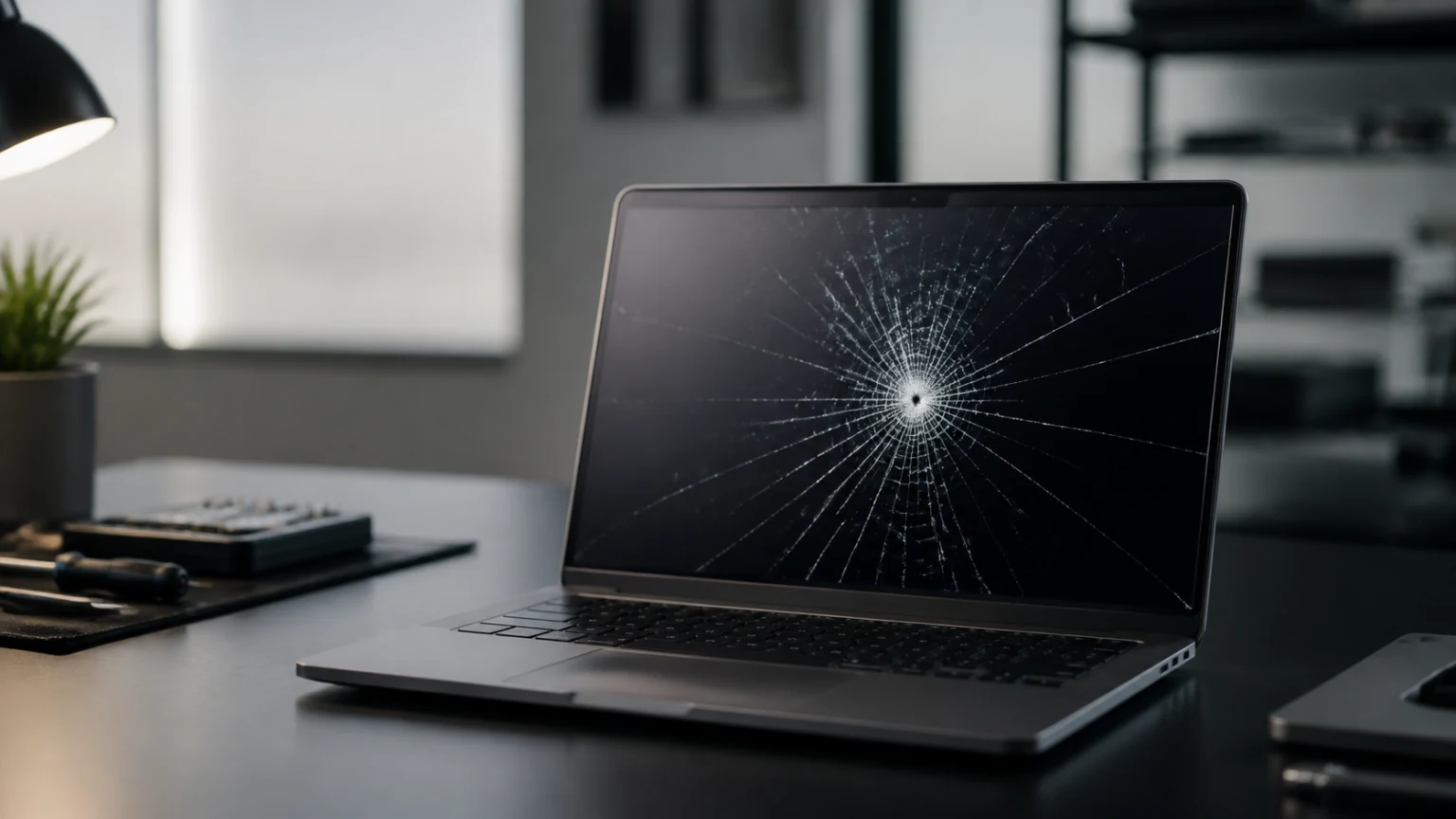
Do these three things before you price a screen
- Leave the damage alone. Do not press the panel, flex the lid, tape over the crack, add glue, or keep opening and closing a stiff hinge.
- Photograph the whole laptop. Capture the screen, lid, hinges, base, ports, and any gaps or dents. A close-up of the crack alone can hide the part that changes the repair.
- Record the exact machine. Save the model, service tag or serial number, and the display features you already had. A screen size by itself is not enough to identify the right part.
If loose glass or sharp plastic is present, keep hands away from it and carry the laptop in a rigid container that does not push on the lid. Do not put it loose in a backpack with a charger or books pressing against the damaged screen.
A cracked screen can involve more than the panel
The visible image comes from the display panel, but a laptop lid can also contain a cable, camera, microphones, antennas, touch layer, sensors, brackets, and hinge mounts. One drop can damage several of them.
- Display-only signs: localized cracks, ink-like black patches, colored lines, or a dead image while the lid and base stay aligned.
- Cable or hinge signs: the image changes as the lid moves, the hinge clicks, a corner lifts, or the bezel separates.
- Wider impact signs: the computer will not start, the base is bent, ports moved, the keyboard or trackpad changed, or the battery area looks distorted.
- Feature-specific signs: touch, camera, microphone, brightness control, or lid-close behavior stopped working after the impact.
Do not keep flexing the lid to reproduce an intermittent image. Repeated movement can turn a repairable mount or cable problem into more enclosure damage. If the hinge is already separating the case, use the separate broken laptop hinge guide and stop moving the lid.
Can you use an external monitor?
An external display can be a useful temporary path to your files when the base, battery, ports, and hinge area appear stable. HP’s current damaged-screen guidance also identifies an external monitor as a possible workaround. It does not prove the laptop is safe or that the screen is the only failed part.
If there is no swelling, heat, odor, smoke, structural movement, or exposed material, place the laptop on a stable surface and connect a known-good display without forcing any port. Keep the damaged lid in one position. If the computer starts, back up important files before doing anything that adds risk.
A working external image tells you the computer can produce video through that path. It does not clear the display cable, lid, hinges, internal panel, camera, battery, or enclosure. A failed external image also does not prove the main board is bad; the output, cable, input selection, startup state, and graphics path still need to be separated.
Get a quote for the exact display configuration
Laptops sold under one family name can ship with several incompatible screens. Before anyone orders a part, confirm as many of these as the model supports:
- exact model, product number, service tag, or serial number
- screen size and native resolution
- touch or non-touch construction
- refresh rate, brightness, color, or high-dynamic-range option
- panel connector, cable position, and mounting style
- camera, microphone, privacy shutter, face sign-in, or ambient-light sensors
- lid color and whether the available repair is panel-only or a complete display assembly
Dell’s current cracked-screen guidance routes owners through coverage and model-specific service. That is the right principle even when another repair provider does the work: identify the machine and damage scope before naming a part, price, or turnaround.
When repair is the stronger choice
A screen repair is easier to justify when the laptop has a stable chassis, sound hinges, a useful battery, adequate performance, supported software, and no other expensive failure. It is also stronger when replacing the machine would mean buying a noticeably more expensive model to keep the same memory, storage, ports, touch features, display quality, or specialized software.
Include setup costs that do not appear on a store price tag. Data transfer, application installation, account recovery, licensing, docks, adapters, and time away from work all matter. If the laptop already fits your workflow and the repair leaves it dependable, fixing one failed assembly can be the practical option.
When replacement deserves a serious look
Replacement becomes more reasonable when the screen is only one part of a larger bill. Look beyond the crack:
- the lid, hinges, hinge mounts, or base also need structural repair
- the battery is weak, swollen, or already due for replacement
- storage is failing, memory is inadequate, or the machine cannot run the software you need
- the operating system or critical applications are nearing the end of support for that hardware
- the exact display is unavailable, uncertain, or unusually costly
- a suitable replacement includes a meaningful warranty and solves several current limitations at once
Compare like with like. A low advertised replacement price is not equivalent if it has less memory, smaller storage, a dimmer display, fewer ports, weaker construction, or no touch capability. And do not let an arbitrary “50 percent rule” make the decision for you. Use the actual repair quote and the actual replacement you would buy.
Check coverage before approving paid repair
Standard warranties often treat impact damage differently from a manufacturing defect. Accidental-damage plans, store protection, homeowner or renter coverage, and some card benefits can have separate terms, deductibles, evidence requirements, and claim deadlines.
Save photos and the impact date before changing the condition. Check the official coverage route for the exact device. Do not assume a cracked panel is covered, and do not let anyone promise a claim outcome without reading the current terms.
What a useful written quote should tell you
A quote should explain what was identified and what remains uncertain. Ask for:
- the exact part or assembly being priced
- whether touch, camera, sensors, cable, bezel, lid, or hinges are included
- whether structural damage could change the price after opening
- the part grade and repair warranty
- the expected turnaround and any parts-delay risk
- what happens if the computer has wider damage or the part is incompatible
- how your data will be handled and whether a backup is recommended first
For a Dell laptop with an intact, stable enclosure, Dell documents a D-key-plus-Power LCD self-test on supported models. That test can help separate display hardware from software, but it is Dell-specific and it does not make a cracked or structurally unstable lid safe to move.
Protect your files before service or replacement
If the laptop is safe to power and you can reach the desktop through the remaining image or a temporary external display, back up important files. Confirm that the backup opens from another device or location. A copy command finishing is not the same as a verified backup.
If the laptop is unsafe to power, will not start, or holds the only copy of important data, stop experimenting. Ask about data-recovery options before authorizing disposal, board exchange, reset, or storage replacement.
Bring the whole decision to the inspection
- the exact model or service tag
- photos of the screen, lid, hinges, and base
- what happened and when
- whether the computer still starts or works on an external display
- any heat, odor, swelling, hissing, smoke, case movement, or sharp exposed material
- the original screen features and any earlier repair
- your current backup status
- the replacement laptop you would realistically buy, not just the cheapest listing
Budget Repair can inspect the physical damage and prepare a model-specific path. Review our computer and laptop repair service, use the screen-flicker guide when the panel is intact, or request an initial quote. Inspection comes before a confirmed part, final price, turnaround, data outcome, or repair recommendation.
Editorial sources
Checked August 20, 2026 against Dell Support’s current cracked or broken LCD service guidance and Dell laptop LCD self-test instructions, plus HP Support’s damaged laptop screen guidance. Budget Repair added the safety stop conditions, exact-configuration checklist, external-display limits, written-quote questions, and repair-versus-replace framework. No universal price, age, or percentage rule is presented as vendor guidance.