
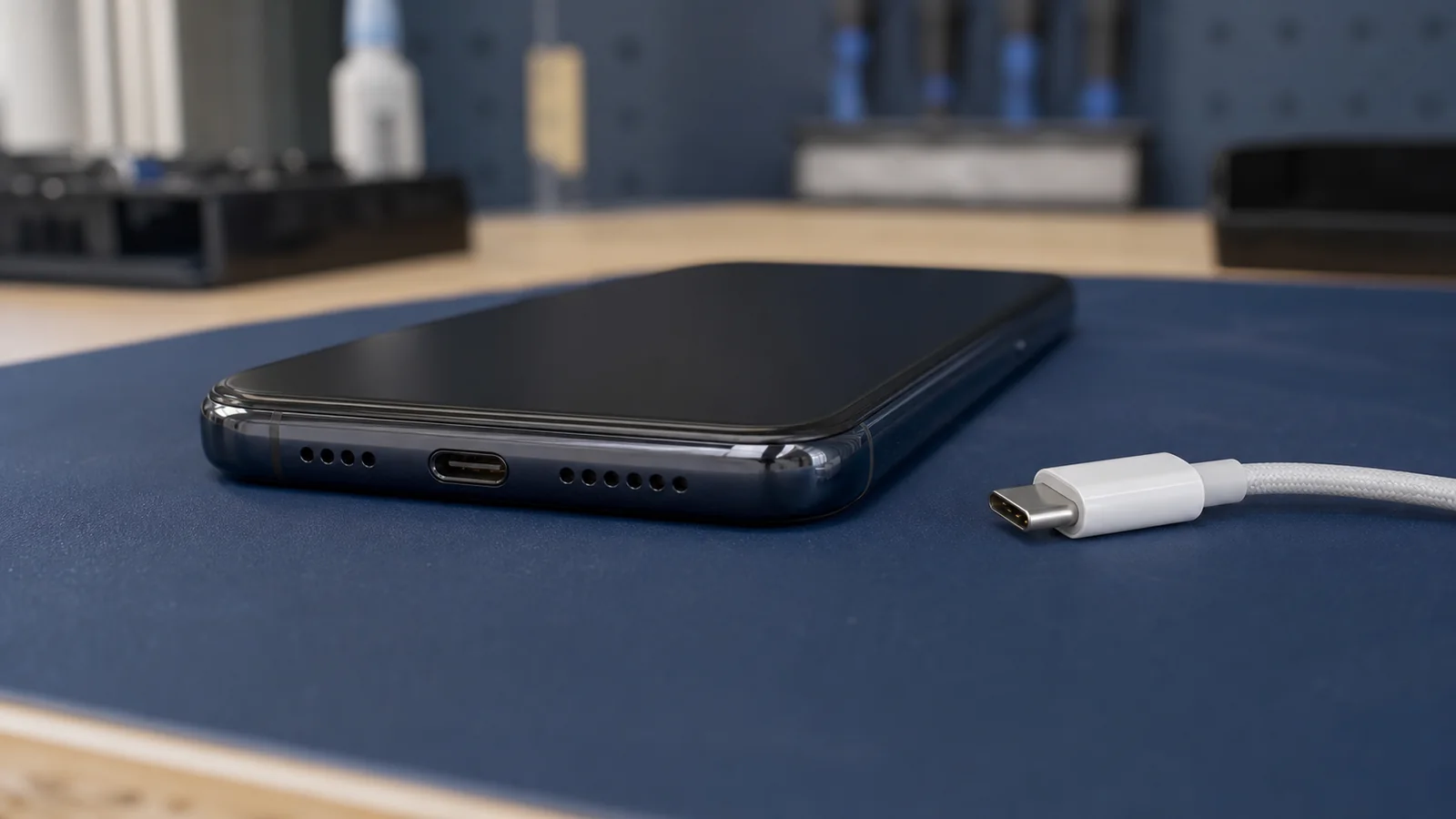
Match the symptom before you blame the port
“Not charging” can describe several different conditions. An iPhone that shows no charging symbol may not be receiving power at all. Slow charging can point to the power source, adapter, cable, temperature, or current workload. A charge that stops near 80 percent may be an intentional battery setting or temperature protection. An accessory warning can involve the cable, charger, debris, or damage. A liquid-detection alert is a safety branch of its own.
Write down what appears on screen, whether wireless charging still works, which accessories were tested, and whether the problem began after a drop, moisture exposure, or a hard sideways pull on the cable. Those observations narrow the next step without pretending they prove which component failed.
Use this safe check order
- Check the outlet and connections. Plug the adapter directly into a known-working wall outlet. Confirm the cable is fully seated at the adapter, but do not force the connector into the phone.
- Inspect the cable and adapter. Stop using an accessory with a split jacket, bent prongs, damaged connector, discoloration, or unusual heat. Compare with another compatible known-good cable and charger.
- Restart the iPhone. A restart can clear a temporary charging or accessory-recognition problem. Use Apple's model-specific restart instructions if the phone is unresponsive.
- Let it charge undisturbed. Apple recommends allowing 30 minutes before reassessing a phone with a very low battery. Do not keep unplugging, rotating, or wiggling the cable during this test.
- Compare wired and wireless charging, if supported. Wireless charging working while several wired accessories fail is useful evidence about the wired path, but it does not prove the connector itself is the only fault.
- Check for an alert or charging limit. Read the exact message. “Liquid Detected,” “Accessory Not Supported,” and stopping at a configured limit lead to different next steps.
What common charging symptoms can mean
No response with one cable
Test that cable and adapter separately if practical, then try another known-good compatible set. One failed combination is not enough evidence to diagnose the phone. Also confirm the wall outlet works with another device.
Charging only at an angle
A connection that appears only when the cable is held or pushed can be caused by connector wear, debris, a damaged cable end, or physical port damage. Stop applying sideways pressure. Repeated movement under power can worsen a loose connection or damage contacts that were still repairable.
Charging stops near 80 percent
This is often not a port symptom. Apple explains that Optimized Battery Charging, a configured Charge Limit on supported models, or temperature protection can pause charging around that level. Let the phone and charger return to a comfortable room temperature and review the battery charging settings before requesting hardware repair.
“Accessory Not Supported” appears
Connect the phone directly to the charger without an adapter or hub, restart it, and compare with another compatible cable and charger. Apple lists a dirty or damaged port, a defective accessory, and an unsuitable charger among the possible causes. The alert does not identify one cause by itself.
If the iPhone reports liquid, stop wired charging
A liquid-detection alert means the iPhone detected moisture in the Lightning or USB-C connector, on the cable, or on the accessory. Disconnect both ends of the cable. Leave the phone in a dry area with airflow and keep the connector facing down when practical. Apple says it can take up to 24 hours to dry fully.
If the alert returns every time with a dry, known-good Apple cable or accessory, service may be appropriate. Repeated alerts are still not proof that the charging port alone needs replacement; the phone and accessory need direct inspection.
Where safe cleaning ends
Apple's charging guidance includes removing debris, but its handling guidance also says never to force a connector and not to use compressed air. Its liquid guidance specifically warns against inserting cotton swabs, paper, or other foreign objects. For a user-facing safety boundary, inspect only from outside under good light. Do not insert metal, wood, plastic, paper, liquid cleaner, or an air nozzle into the port.
If compacted material is visible inside the connector, professional cleaning is safer than improvising with a pick. Modern Lightning and USB-C contacts are small, and damage can turn a cleaning problem into a connector or board repair.
Signs the phone needs physical inspection
- Several compatible known-good cables and adapters fail at more than one working outlet.
- The connector will not seat normally, feels much looser than before, or falls out without tension.
- Charging starts and stops with slight movement, or works only while the cable is held at an angle.
- The port shell or contacts look bent, shifted, corroded, or damaged after a drop or cable pull.
- A dry phone repeatedly shows a liquid alert with a known-good cable.
- The cable, connector, or phone becomes unusually hot, or the phone shows swelling, odor, smoke, or separation of the screen or case.
Stop using the device immediately for swelling, smoke, odor, or unusual heat and keep it away from pressure and flammable materials. Do not open the phone or try to remove a battery. For ordinary intermittent charging, an inspection should distinguish the accessory, connector, battery, and charging circuit before anyone promises a specific replacement.
What a useful repair diagnosis should answer
A careful check reproduces the symptom with known-good power equipment, examines connector fit and contact condition, and considers battery and board-level charging behavior. Ask whether cleaning or connector damage was verified and whether charging remains stable without cable pressure after service.
For local help, review Budget Repair's iPhone repair service and broader repair services. If the safe checks above still fail, you can request an inspection estimate and include the cable, adapter, outlet, alerts, and charging methods already tested. More diagnostic guides are available in the Budget Repair blog.
Editorial sources
Checked July 15, 2026 against Apple's official guidance for an iPhone that will not charge, liquid-detection alerts, and important iPhone handling information. Budget Repair added the symptom-to-next-step structure, conservative cleaning boundary, and repair handoff criteria.