
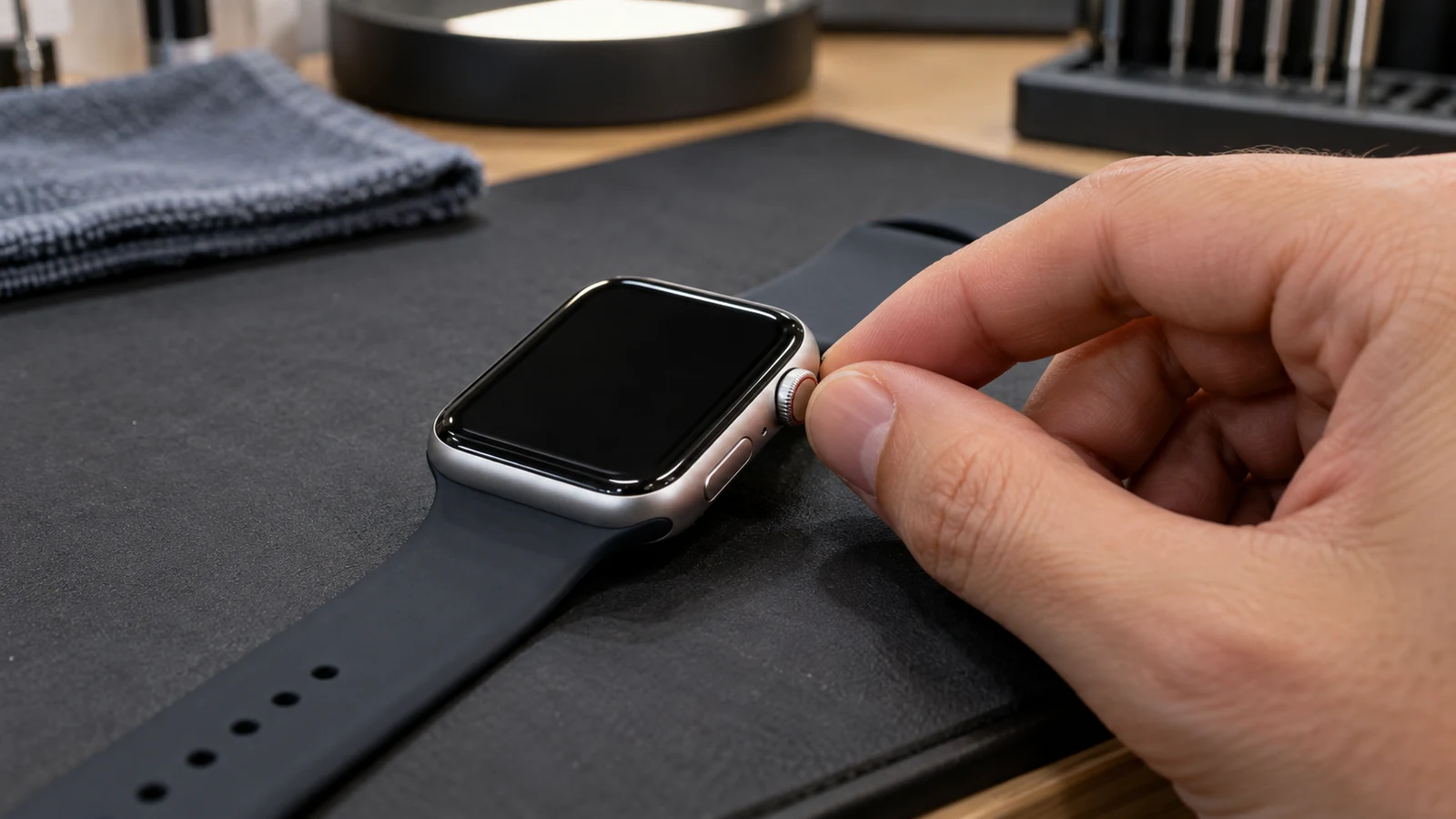
Record how the Digital Crown behaves
Remove the watch from its charger and note the exact model, watchOS version, recent update, case or protective film, and any drop or liquid event. Then describe the control itself. Does it turn? Does it click? Does either action work anywhere in watchOS? Does the problem come and go?
A crown that feels gritty or will not move has a different starting point from one that spins and clicks normally but does nothing on screen. An action that fails only in one app or after a software change is different again. These observations do not diagnose the hardware, but they keep the next check tied to the symptom you can reproduce.
Stop before adding water when the watch may be damaged
Apple says water resistance is not permanent and can diminish after drops and other impacts. Do not rinse a watch with cracked glass, an open seam, visible impact damage, a missing or loose crown, unusual heat, swelling, odor, smoke, or known liquid exposure. Turn it off if that can be done normally and safely. Do not charge or keep testing unsafe hardware.
If liquid exposure is part of the history, use the safety boundaries in the liquid-damage first steps. The page is written for phones, but its stop points around power, heat, charging, and unsafe drying methods also explain why repeated powered tests can make a damaged device harder to assess.
Remove anything that blocks the crown
Apple's Digital Crown guidance starts with protective films and cases. Remove an accessory only when it comes away normally. Do not cut, pry, or force a tight case against the crown. With the accessory off, check whether the crown can turn and click without extra pressure.
Look around the outside of the crown under steady light. Note visible dust, residue, corrosion, a gap that looks uneven, or a crown that sits differently from before. Do not push a pin, brush, cloth edge, or swab into the gap. Visible damage or a missing crown ends the home check.
Clean an intact watch once
For an intact watch with debris around a stuck crown, Apple says to turn off the watch, remove it from the charger, and remove a leather band. Hold the Digital Crown under lightly running warm fresh water. Turn and press the crown while the water passes over the small gap between the crown and case. Do not use soap or another cleaning product.
Dry the watch with an absorbent, nonabrasive, lint-free cloth. Turn and press the crown as you dry the outside surfaces. Let the watch return to a dry, normal condition before checking it. Do not use heat, compressed air, sprays, solvents, ultrasonic cleaning, or rice.
This step may remove external debris. It cannot prove that a seal, sensor, flex cable, or other internal part is healthy. Do not repeat the rinse if one controlled attempt leaves the result unchanged.
Try one standard restart when the watch still responds
If the crown moves normally and the watch responds to the side button or screen, use Apple's standard restart path once. Remove the watch from its charger. Use the normal power controls to turn it off, then hold the side button until the Apple logo appears.
Retest the same crown action after watchOS loads. Do not stack a restart, reset, unpairing, update, and cleaning attempt together. One change at a time makes the result useful. Apple limits a force restart to cases where a standard restart is unavailable, so it does not belong in a routine repeated test.
Separate one-app behavior from a system-wide failure
Check the crown in a normal system view and in the app where the symptom first appeared. Record whether turning and pressing fail everywhere or only in one app, screen, or gesture. A software-specific result may need an app or watchOS support path. A crown that is physically stuck, damaged, intermittent, or unresponsive throughout the system needs inspection.
Do not erase or unpair the watch merely to see whether a physical control starts moving. Preserve the paired iPhone, current software version, recent update timing, and any error or accessibility setting that affects how the control behaves.
Know when home testing is finished
Apple routes a Digital Crown that remains unresponsive, damaged, or intermittent to repair. Stop after the case or film check, one safe cleaning attempt on an intact watch, and one standard restart when those steps fit. Repeated force, liquid, resets, or accessory swaps will not identify the internal cause.
If the same watch also has a power problem, use the Apple Watch not charging guide before adding more charging tests. Keep the crown symptom separate from battery and charger behavior.
Bring a useful record to inspection
Write down the exact model, watchOS version, crown movement and click state, where the response fails, the case or film used, what changed recently, and any impact or liquid history. Add the result of the single clean or restart that you completed. Those facts are more useful than guessing which part needs replacement.
Budget Repair can review the device details and tell you whether a local inspection or quote is available. Use the instant quote form and include the exact Apple Watch model and the crown state. Inspection comes before any promise about repairability, price, turnaround, data retention, warranty coverage, or outcome. More device guides are in the Budget Repair blog.
Editorial sources
Checked October 7, 2026 against Apple's Digital Crown support guidance, Apple Watch cleaning instructions, water-resistance limits, and restart instructions. Apple supplies the case, debris, cleaning, restart, water, and repair boundaries. Recent owner reports were used only to check current symptom wording for physical stiffness and missing system response. Budget Repair added the four-state record and one-change-at-a-time order. No source proves the failed part or the repair outcome from the symptom alone. Budget Repair is not affiliated with Apple.