
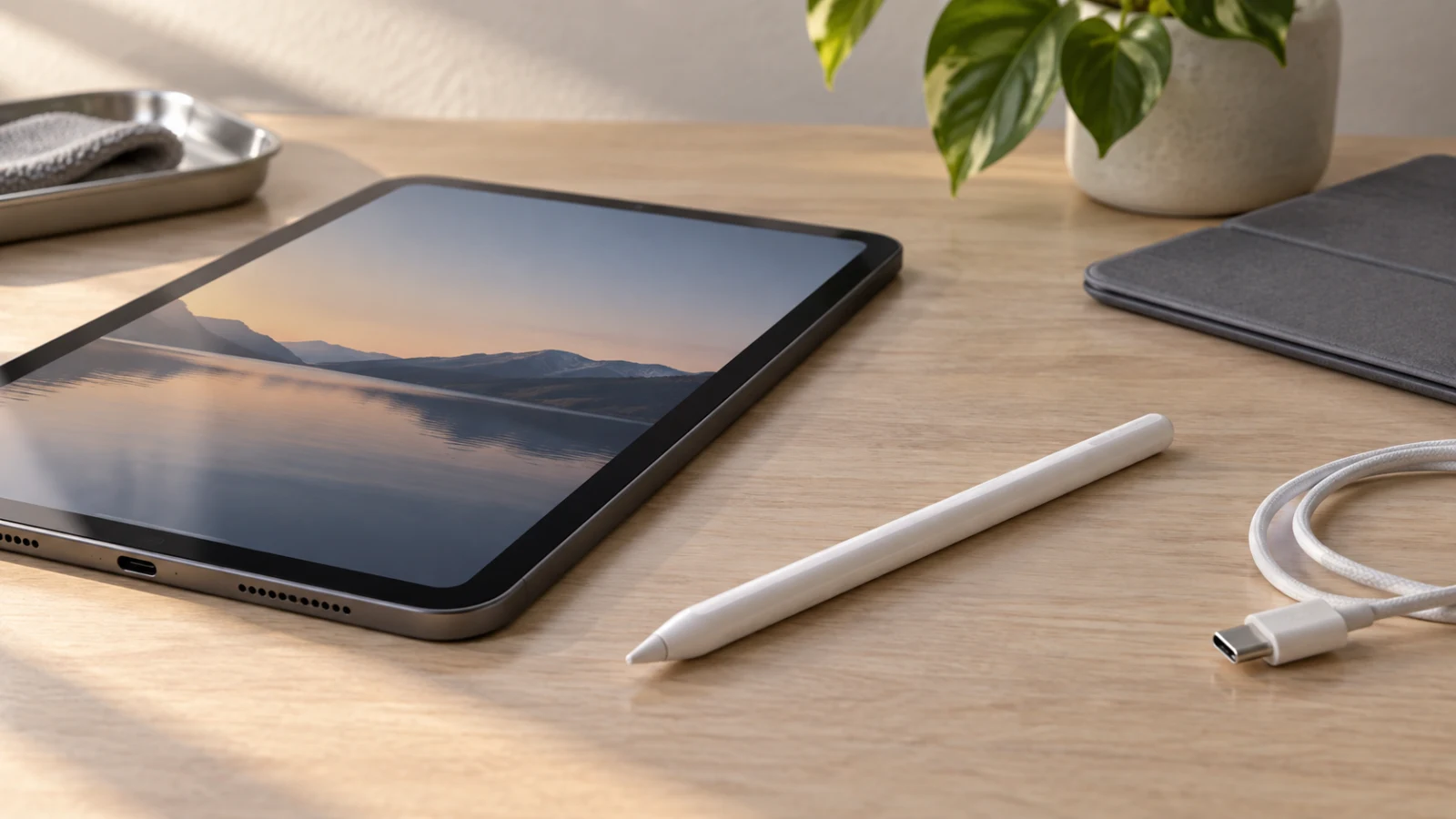
Identify the Apple Pencil model first
The charging method changes with the Apple Pencil model. Look for a magnetic charging edge, a USB-C port under a sliding cap, or a Lightning connector. Match the Pencil to the compatible iPad and cable before treating a no-charge result as a hardware failure.
| Apple Pencil model | Charging path | Useful check |
|---|---|---|
| Apple Pencil Pro or 2nd generation | Attach the Pencil to the magnetic connector on a compatible iPad. | Remove a case that blocks contact, then check the battery view after the Pencil seats normally. |
| Apple Pencil (USB-C) | Open the sliding cap and connect a USB-C cable to a compatible iPad or power adapter. | Use a cable and adapter that work with another device, then check the battery view. |
| Apple Pencil (1st generation) | Connect the Lightning connector to a compatible iPad. With iPad (10th generation), use Apple's USB-C to Apple Pencil Adapter and a USB-C cable. | Keep the connector straight and stop if it does not seat without pressure. |
Do not use the connector from a different model as a test. If the model is unclear, record the iPad model, the Pencil connector or magnetic behavior, and any adapter in the setup before changing anything.
Check the compatible iPad and power path
Update the iPad through its normal software update screen if an update is already offered and the iPad is safe to use. Then trace the charging path from the iPad or wall adapter to the cable, connector, and Pencil. Change one part at a time so the result stays useful.
| Check | What to do | What the result means |
|---|---|---|
| Magnetic connection | Remove a thick case, align the Pencil with the iPad's magnetic connector, and leave it in place. | A case or misalignment can prevent charging contact without proving a battery failure. |
| USB-C or Lightning cable | Use the cable that matches the model. Check for cuts, crushed sections, bent ends, discoloration, or unusual warmth. | Visible damage is a stop condition, not a reason to wiggle the connector. |
| Adapter and outlet | For a cable-based model, use a compatible power adapter and a known-working outlet or iPad connection. | A dead outlet or adapter can look like a Pencil failure. |
| Connector and port | Use steady light to look at the outside of the connector and iPad port. Do not probe inside. | Debris, liquid, or a bent contact needs careful inspection rather than force. |
Give the Pencil time to show a battery status
Leave the Pencil connected through the correct path for about one minute before deciding that nothing happened. Check the Batteries widget or Settings > Apple Pencil on the iPad. A battery reading supports an active connection, but it does not prove that every cell, connector, cable, or internal circuit is healthy.
Write down the model, iPad, cable or magnetic position, adapter, outlet, start time, and battery result. Avoid repeatedly disconnecting the Pencil while you are trying to read a change.
Restart and pair once
If the Pencil still does not charge or pair, restart the iPad once. Make sure Bluetooth is on, then reconnect the Pencil through its model-specific path. If a Pair button appears, use it once and wait for the result.
Apple's pairing guidance is model-specific. A restart or pairing attempt can clear a temporary connection problem, but it cannot repair a damaged port, battery, connector, or charging circuit. Do not erase the iPad, repeat resets, or buy a replacement part from the charging symptom alone.
Clean only what you can see safely
Disconnect the Pencil before cleaning. Wipe the outside with a soft, dry, lint-free cloth. Let a wet device dry naturally before another test. Do not spray cleaner into a port, use a pin or blade, pour liquid onto the Pencil, or use heat to make a battery respond faster.
If material is inside a port and does not lift without pressure, stop. Keep the Pencil, iPad, cable, and adapter together for inspection.
Stop when the hardware looks unsafe
Disconnect power if the Pencil or iPad becomes unusually hot, smells burnt or sweet, swells, crackles, smokes, leaks, or shows liquid or impact damage. Do not put damaged battery hardware in a case, bag, drawer, or vehicle. Keep it away from heat and anything that can catch fire, and contact an appropriate repair or disposal service for advice.
The charging symptom alone cannot identify whether the failure is in the cable, adapter, port, battery, connector, iPad, or another circuit. Do not open the Pencil or make a part purchase from the symptom alone.
Bring the test record to inspection
If the model-correct charging path, one-minute wait, battery check, restart, and pairing attempt do not restore a normal result, home testing is finished. Keep the Pencil, iPad, cable, adapter, model information, and notes together. Include any drop, liquid, heat, or prior-repair history.
Budget Repair works on many tablet and charging problems, but Apple Pencil inspection depends on the exact model and condition. Review the iPad repair page, then ask whether inspection is available before making a trip. Inspection comes before any promise about a failed part, repairability, price, turnaround time, warranty decision, or outcome. More device checks are available in the Budget Repair blog.
Editorial sources
Checked October 5, 2026 against Apple's Apple Pencil pairing and charging guidance, Apple Pencil USB-C charging and battery guidance, and Apple service and repair information. Apple supplies the model distinction, charging paths, battery checks, and pairing boundary. Budget Repair added the one-change-at-a-time record, stop points, and local inspection boundary. No source proves the failed part, repairability, price, timing, or outcome from a no-charge symptom alone. Budget Repair is not affiliated with Apple.